Explore the seven career paths
1. Clinical AI Evaluator 2. Healthcare Large Language Model (LLM) Evaluator 3. AI Quality and Safety Reviewer 4. Clinical Data Annotator 5. Healthcare AI Trainer 6. Nursing Informatics and AI 7. Clinical AI Subject-Matter Expert (SME) Taking Practical Steps Toward a Clinical AI CareerIf you’re a registered nurse curious about the expanding world of healthcare artificial intelligence (AI), you might wonder how your clinical expertise fits into this dynamic field. While nursing skills alone don’t automatically translate into AI roles, your clinical judgment, communication abilities, and commitment to patient safety offer a strong foundation. Understanding specific career paths and the skills involved can help you make informed choices about your professional journey.
1Clinical AI Evaluator
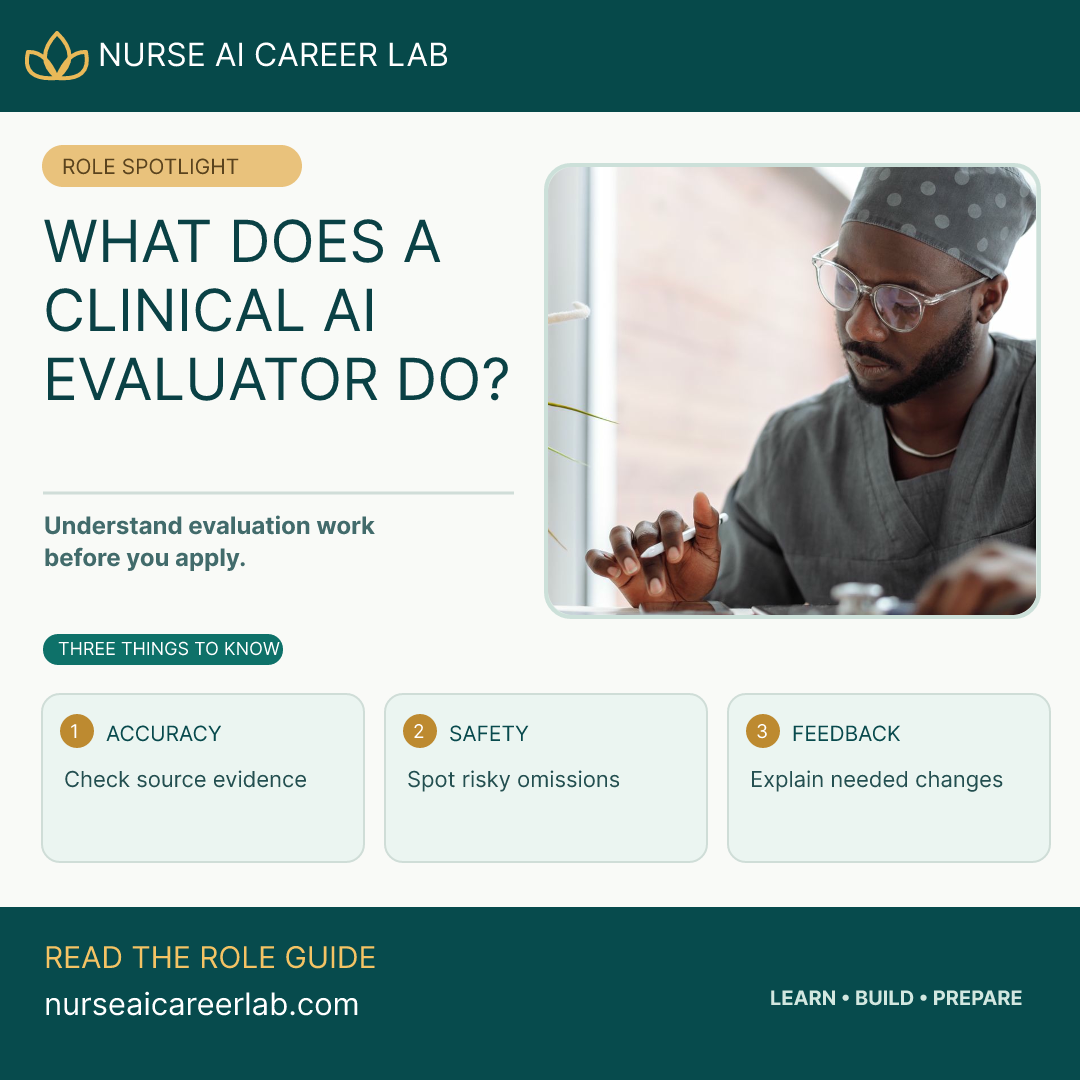
Clinical AI evaluators play a vital role in reviewing AI-generated clinical content to ensure it’s accurate and appropriate. For example, if an AI summary misses a documented medication allergy, you would spot this and explain why it matters clinically. Nurses skilled in chart review, clinical assessments, and escalation protocols bring essential insight to this position. Some roles may require additional training in AI evaluation methods.
2Healthcare Large Language Model (LLM) Evaluator
Large Language Models generate natural language responses based on input data. Evaluators assess these answers for clarity, accuracy, and appropriate handling of uncertainty. Imagine reviewing two AI-generated responses to a patient’s vague symptom: one confidently offers a diagnosis without enough information, while the other suggests further assessment. Nurses with strong clinical judgment and communication skills help determine which response aligns better with safe nursing practice.
3AI Quality and Safety Reviewer
Quality reviewers audit AI outputs using structured criteria to identify safety risks, inconsistencies, or misleading information. This role focuses on spotting potential hazards in AI-generated content without providing clinical advice. Nurses familiar with safety reporting, evidence-based documentation, and quality improvement initiatives often find this work suits their expertise.
4Clinical Data Annotator
Annotators label clinical data to train or validate AI models. For instance, distinguishing between symptoms present and symptoms explicitly denied in clinical notes is crucial for AI accuracy. Nurses with keen attention to detail and familiarity with clinical terminology excel in annotation tasks. Some roles may require learning specific annotation software or guidelines.
5Healthcare AI Trainer
AI trainers help improve system performance by reviewing outputs, providing feedback, and refining training data. Nurses who have taught patients or mentored colleagues may find their communication skills transferable here. This role often involves working with detailed evaluation rubrics and understanding AI-specific terminology, so reviewing job requirements carefully is important.
6Nursing Informatics and AI
Nursing informatics professionals act as a bridge between clinical workflows and technology. In AI projects, they clarify where clinical data originates, who verifies it, and how human oversight integrates with AI tools. Nurses experienced with electronic health records, handoffs, and documentation standards bring valuable context. Some positions may require additional informatics training or certifications.
7Clinical AI Subject-Matter Expert (SME)
Subject-matter experts provide guidance on clinical requirements for AI development. For example, an SME might specify necessary allergy alert details for safe nursing interpretation. This role typically demands extensive clinical experience and the skill to communicate complex concepts to technical teams.
Taking Practical Steps Toward a Clinical AI Career
Start by identifying one or two roles that resonate with your interests and background. Review current job descriptions to understand the qualifications, technical skills, and responsibilities involved. Reflect on your nursing career to identify concrete examples that demonstrate transferable skills, such as detecting documentation errors, applying safety protocols, or simplifying complex clinical information.
Next, familiarize yourself with clinical AI concepts and terminology. Practice using fictional clinical scenarios to build confidence while protecting patient privacy. When updating your resume, focus on portraying your relevant experience accurately without overstating AI expertise.
Nurse AI Career Lab offers a free AI Career Fit Check designed to help nurses explore clinical AI career paths based on their experience. This assessment is a helpful starting point—not a guarantee of job placement or eligibility. For those seeking deeper learning, paid membership provides curated educational resources, resume-building tools, application tracking, and interview preparation.
Explore where your nursing expertise could lead
Discover two possible clinical AI career directions and practical next steps with the free Career Fit Check.
Take the free Career Fit Check → Explore membership toolsPublished for career education, not patient-care decisions or employment guarantees. Verify current employer requirements and avoid identifiable patient information in practice exercises.